

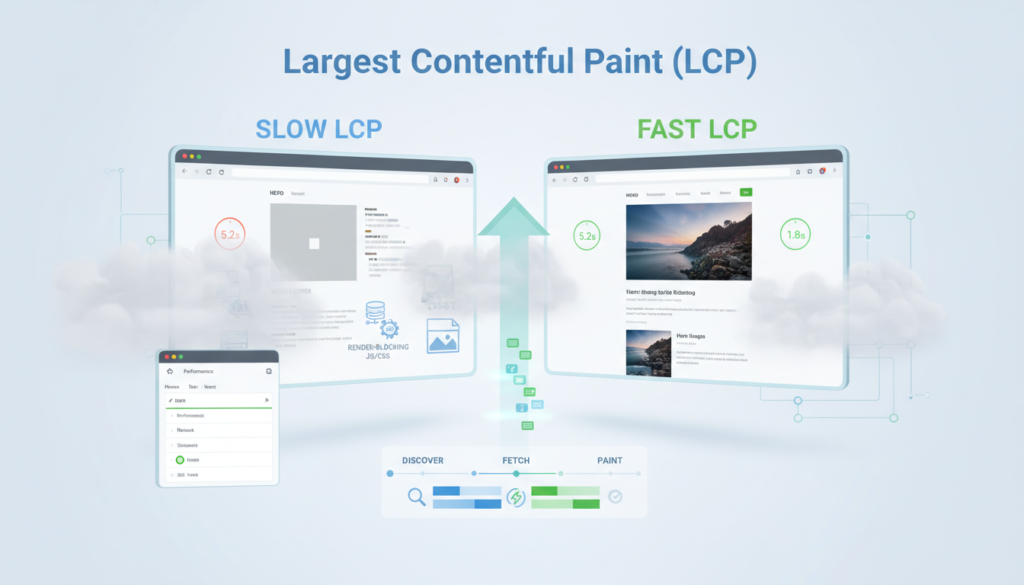
1. Largest Contentful Paint (LCP)
Advanced Techniques for Improving Core Web Vitals in 2026:
In 2026, Core Web Vitals performance wins come from doing the unglamorous stuff well, which is precisely where specialized page speed optimization services move beyond generic checklists and into architectural-level improvements that actually move the needle.
- Prioritizing the right requests
- Reducing main-thread work
- Controlling third-party scripts
- Shaping the loading sequence
Here’s what I actually do when a site needs real improvement.

1. Make LCP better by prioritizing the hero properly
If you want better LCP, you’re usually trying to get one element to paint quickly and consistently.
My preferred approach:
- Identify the LCP element (don’t assume; it changes across templates).
- Ensure it’s discoverable early:
- Avoid hiding it behind client-side rendering, and also avoid CSS background images for critical visuals
- Use responsive images:
- Correct sizes with sensible breakpoints
- Keep it small:
- AVIF/WebP where it makes sense, and avoid retina
2. Reduce server response times (TTFB) like you mean it
3. Eliminate render-blocking resources without breaking the site
4. Stop JavaScript from hijacking the main thread
5. CLS hardening: reserve space everywhere
6. Third-party scripts: pick your battles (and win them)
2. AI-Driven Personalization Can Destroy CWV (Unless You’re Disciplined)
FAQs:
Do it in this order (because this matches how problems usually show up):
Fix CLS: reserve space for images, banners, embeds; stabilize fonts.
Fix LCP: prioritize the hero, reduce TTFB, eliminate render blockers.
Fix responsiveness and set up monitoring: cut JS, defer non-critical scripts, and remove long tasks.
If you’re talking about a single “score” (like Lighthouse 0–100), treat it as directional.
In practice, “good” means your important templates consistently hit:
LCP under the recommended threshold (often cited as < 2.5s)
low layout shift (CLS < 0.1)
fast interactivity (FID < 100ms, conceptually; and strong responsiveness overall)
If your scores are great in the lab but users complain the site feels laggy, believe the users.
Playbook for improving Core Web Vitals score:
Ship less JavaScript. Most teams ship too much.
Control third parties. Tag managers are performance tax collectors.
Make LCP predictable. Stable hero, preloaded appropriately, responsive images.
Harden against CLS regressions. Reserve space everywhere.
Measure real users. Lab tools are not your users.
A small but important habit: every time you add a feature, ask “what does this do to the main thread?” If nobody can answer, you’re flying blind.







Comments