

Every growing business hits this wall at some point. You need proper WordPress expertise, and you need it soon, before any error lets your WordPress site down. So you start researching the ” in-house WordPress developer vs. agency question, and within twenty minutes, you have found many articles that all say the same thing. “Both options have pros and cons.” “It depends on your needs.” “Consider your budget and timeline.” None of them is lying, exactly, but none of them is actually helping you decide either. This article is different. Real cost numbers, honest trade-offs, the ugly surprises most businesses only learn after they have already committed to the wrong path- it is all he
Table Of Contents:
- In-House WordPress Developer vs Agency: Which Is Better for Your Business?
- What an In-House WordPress Developer Actually Costs You
- The Skill Gap Nobody Warns You About
- WordPress Developer vs Agency: What You Are Actually Comparing
- When an In-House Developer Is the Right Answer
- When a WordPress Development Agency Makes More Sense
- The Scalability Problem Most Businesses Only Understand After It Has Happened
- Making the Call That Fits Your Business
- FAQ’s:
- For a business, is it more budget‑friendly to hire a full‑time WordPress developer than to pay an agency?
- What does working with a WordPress agency give you that one developer cannot?
- How do you know when your business should move to an agency model?
- How do I test whether an agency’s skills are genuine or just marketing talk?
What an In-House WordPress Developer Actually Costs You
The salary number is not something you use to decide whether to choose an in-house WordPress developer vs. an agency. Say you hire a mid-level WordPress developer at $80,000 per year, though the salary can be negotiated based on the company’s budget and the developer’s level of expertise. Sounds manageable. But by the time you add payroll taxes, health insurance, equipment, software licence, paid time off, and sick days, that $80,000 turns into $110,000 or more. Some businesses end up closer to $130,000 once onboarding costs and the HR overhead of managing a new employee are factored in.
Then there is the timeline problem because recruiting a WordPress developer is not a two-week process. This process takes two to three months from posting to final hiring, and after that, a new developer needs another two to three months to get familiar with the company policies and their work.
The Skill Gap Nobody Warns You About
Here is the conversation that plays out in many businesses about a year after they hire their first full-time WordPress developer. “We hired a great developer. Six months in, we realized the site had some serious security gaps, and he was not a security specialist. So we brought in a contractor for that. Then traffic spiked and performance tanked, and the developer did not have deep experience with server-side caching, so we needed another contractor for that. Now we are managing three separate people on top of a full-time salary, and nobody is talking to each other.”
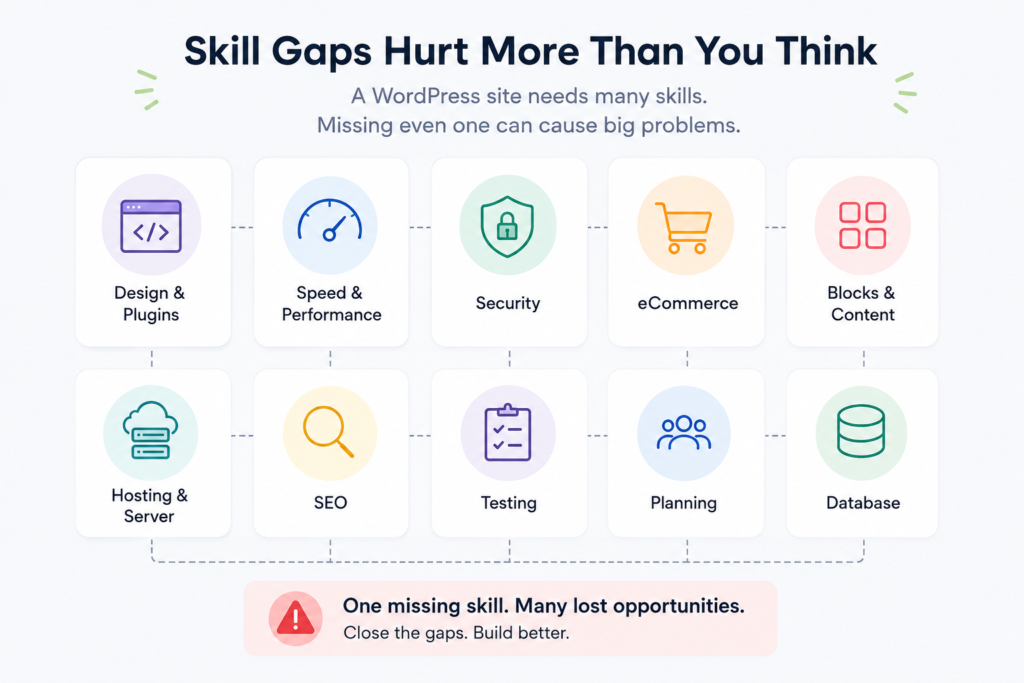
This is not a rare story; it happens because WordPress development is no longer a single discipline. Think about what a production-grade WordPress site actually needs. Custom theme work and plugin development are one area. Performance engineering, caching, database optimization, and server configuration are completely different areas. Security hardening is its own field. WooCommerce has enough depth that specialists exist just for that. Gutenberg block development and headless WordPress architecture are separate again. Technical SEO implementation, QA testing, project coordination- all different.
A developer who is genuinely excellent at custom theme work may have never hardened a server against a brute-force attack. A plugin developer might have strong PHP skills but limited knowledge of server-side caching. Someone who builds headless WordPress setups professionally may not know WooCommerce well at all. These are not skill gaps; they reflect how broad WordPress has become as a platform, and how specialized each area has gotten. One person cannot cover all of it at a high level.
In-House WordPress Developer vs Agency: What You Are Actually Comparing
Before getting into when each option makes sense, it helps to see both clearly side by side.
| Category | In-House Developer | WordPress Development Agency |
| Expertise Available | One person’s knowledge and experience | Team with different specializations |
| Daily Availability | High, part of your team | Structured through project or retainer scope |
| Security and Performance | Limited to the developer’s personal depth | Dedicated specialists per discipline |
| Scalability | Maxes out at one person’s capacity | Scales with your workload as needed |
| Company Knowledge | Builds deeply over time | Requires a discovery phase at the start |
| Typical Annual Cost | $60,000–$150,000 all-in | Variable, according to the plans you buy |
| Risk if Someone Leaves | High total dependency on one person | Low; the team continues without disruption |
| Best Suited For | Consistent, high-volume, long-term work | Project-based work and ongoing support needs |
When an In-House Developer Is the Right Answer
Not every business should go the agency route. There are genuinely good reasons to hire internally, and they come down to a few specific conditions. If your business has a large WordPress platform that needs near-constant development, new features running in parallel, a product roadmap that spans multiple years, and genuinely full-time work month after month, an in-house developer starts to make financial and operational sense.
Especially if you already have an engineering team and you are adding a WordPress specialist to an existing structure rather than building from scratch. If the development work is truly continuous, technically complex, and long-horizon, the in-house investment pays off. If it is not all three of those things, the economics get shaky fast.
When a WordPress Development Agency Makes More Sense
Most growing businesses, if they are honest about their workload, do not have truly continuous development needs throughout the year. They have bursts. A big redesign. A seasonal traffic spike. A new WooCommerce integration. A security audit after something worrying happens.
The agency model is built for that reality. You need a complete site build or major redesign delivered on a real deadline; an agency fits that. Your site has performance issues that are actively affecting revenue, and you need them fixed by someone who does this work professionally: an agency. Your development needs are heavy for three months and quiet for two months.
You want maintenance, monitoring, and updates handled reliably without adding payroll or an agency. You need security, performance, and SEO managed as a connected system rather than three separate contractors who have never spoken to each other. Any one of those situations pushes toward agency. Two or three together, and the decision is pretty clear.
The Scalability Problem Most Businesses Only Understand After It Has Happened
Picture this. Your WooCommerce store runs a major sale. Over about six weeks, your monthly traffic goes from 5,000 visitors to 80,000. The checkout starts slowing down. Load times climb. Your conversion rate drops noticeably, and you can see in the numbers exactly how much money that is costing you every hour.
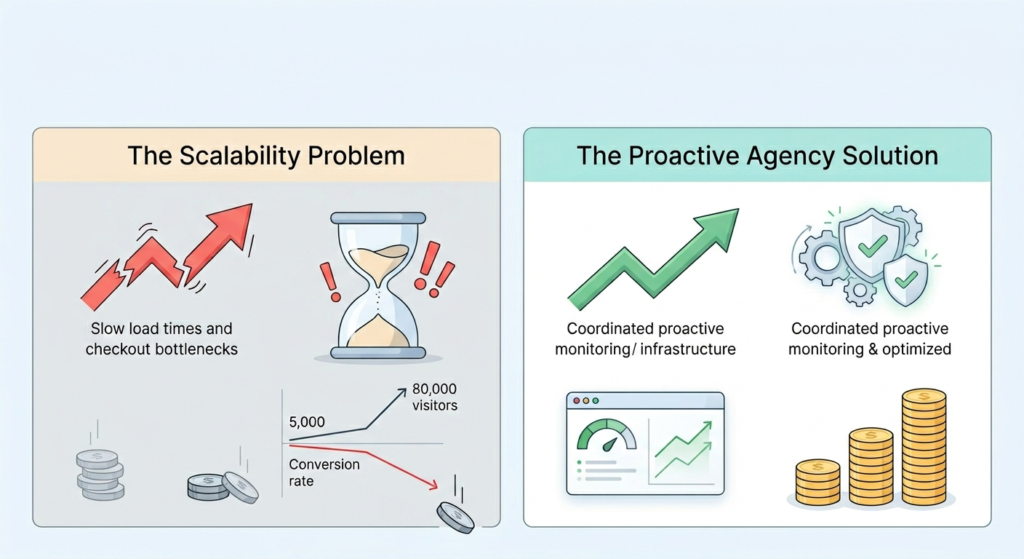
With one in-house developer, your response is limited to whatever that one person can diagnose and fix, working from their existing knowledge of performance architecture. They may be a strong developer. The issue is not their ability; it is the scope of the problem. A traffic spike at that scale usually needs coordinated work across server infrastructure, caching configuration, database queries, and front-end delivery all at once. One person working through that sequentially is not the same as a team addressing it in parallel.
A properly set-up agency retainer changes that situation entirely. Monitoring is already in place. The performance thresholds are already defined. When traffic starts climbing, the team is working on infrastructure scaling proactively, not reacting to a site that is already struggling. The genuine difference between an in-house WordPress developer and an agency is that a team is prepared for your peak period, while a developer is troubleshooting it live at midnight.
That difference compounds over time, too. Every month of proactive monitoring, security patching, and performance work means fewer crises, fewer outages that threaten revenue, and far less of that specific anxiety that comes from not knowing whether your site will hold up when it matters.
Making the Call That Fits Your Business
There is no universal right answer here, and anyone who tells you there is has not thought it through carefully. If your business genuinely has high-volume, continuous WordPress development needs across multiple workstreams, year after year, with a technical team already in place, an in-house hire is worth running the numbers on. Over a long enough horizon, with the right workload to justify it, the investment holds up. For the majority of growing businesses, the more efficient path is a specialized agency. Reliable expertise, built-in scalability, maintenance, and monitoring without payroll overhead, and a team structure that means no single person’s vacation or resignation puts your platform at risk.
When evaluating any agency, hold them to a clear standard: transparent communication, consistent quality across development and ongoing maintenance, and genuine long-term investment in your platform’s health, not just in whatever deliverable happens to be on the current invoice. WPGrit structures its work around exactly that principle, covering custom development, WooCommerce, speed optimization, security, and technical SEO as a single connected service rather than separate work orders with no throughline. Talk to WPGrit — No Sales Pitch, Just Honest Advice
FAQ’s:
A mid-level in-house WordPress developer costs $90,000 to $130,000 per year in total, once salary, benefits, taxes, and equipment are included. A defined agency engagement for a four-month project typically runs around $30,000-60,000, with no recruitment lag, no benefits overhead, and no productivity gap while someone gets up to speed. The in-house economics do start to shift in your favor if the development work is genuinely full-time, technically demanding, and spans several years, but that bar is higher than most businesses realize when they first start considering it.
Breadth of expertise across the right disciplines at the same time. A single developer, regardless of how skilled they are, is limited to what they personally know and what they have personally worked through before. An agency brings a team that has collectively solved the specific problem you are facing across many different client environments. Security, performance work, QA, and project coordination are included in the engagement structure rather than gaps you need to fill separately. That is the practical difference.
Look for agencies that communicate clearly, without vague timelines or evasive answers about scope. Check whether they have genuine depth in the specific areas you need security, WooCommerce, performance optimization, technical SEO- or whether they are generalists making broad claims. Ask how they handle maintenance after a build is complete. The agencies worth working with have a clear answer to that question. The ones that don’t are usually the source of the “we built it and disappeared” frustration that comes up constantly in these conversations.


Comments